WRITING ADVICE: 1st or 3rd person POV
Pinocchio: A short story

Life with no fear?
From the series of “random thoughts I can’t shake off”, I got to thinking about how a highly socialised animal like a human function, were their brain/body unable to feel fear. Partially the question was inspired by a short story “Shudder” by Daniel Morden’s upcoming collection “Strange Tales”.
In most of the animal kingdom, the lack of fear usually means death. A parasite infects a mouse, making it fearlessly approach the cat. The cat eats the mouse, thus providing a fine intestinal habitat for the parasite.
However, in human societies, the lack of survival instinct on this basic level would not mean automatic demise, seeing as tigers and bears seldom roam our streets anymore.
Additionally, some types of survival-based behaviours in humans are simply taught. As a child you learn, for example, that should you be mean to your friends, they will cease to BE your friends. That is unpleasant. A small child might not have a concept of ethics, but they understand the unpleasantness of being left out. So they learn to avoid behaviours that cause it. Same with pain. If you touch the fire, your hand will sting. You learn not to touch the fire. In most people, they learn to experience fear in tandem with the avoidance instincts.
So what if you simply did not experience fear? You wouldn’t know you don’t experience it, necessarily. Humans find iti hard to conceptualise experiences that are alien to them. To a person with aphantasia(where you can’t picture things in your brain), the concept of imagining and conceptualising things develops in a different ways. The brain wires out the gaps, and creates a new mode of behaviour. Yet a seeing person with aphantasia might eventually realise that others do not experience the world in the same way, because the description of the process of imagining something with your eyes closed is related to something they are ALREADY EXPERIENCING.
Not so for a person with no fear. The heart palpitations, the sweaty palms, the fight of flight response… How can that be explained to someone who does not have the same physiological response.
Another question I’m mulling over is how do we categorise fear for such a hypothetical person? Are anxiety, the “jump scare” response, dread and the tingling warning that something wicked this way cometh all one and the same? What about the fight or flight response? Are fear and aggression linked?
Now for the benefits. It’s easy to conceptualise the negative result of experiencing no fear. Would you jump out at the last moment out of the way of a speeding car? Run from suspicious people eyeing you in a dark alley? Possibly, depending on your analytical skills and calculated risk avoidance. But something I wondered about was: would there be long-term positive consequences to the lack of fear response? Often, different pathways wiring their way in the human brain, can bring unexpected benefits. Once more, for people with aphantasia, they can often find their recovery from traumatic events and grief somewhat easier, as their brains don’t play the nasty tricks on them, replying in technocolour the most devastating experiences of their lives. So what, if any, benefits could there be to the lack of fear response?
One possible positive result that popped into my mind is the advantage that comes with risk-taking in business, and life in general (though that can just as well be a negative, as the lack of fear wouldn’t influence the person’s other talents and skill-sets. A bad gamble is the more likely result of over-confidence and underestimating the consequences). What about the joie de vivre? Without fear, would we all truly carpe the hell out of that diem? Or would we once again underestimate the threats? I somehow imagine the survivor bias would be strong in any research ever done on the subject.
So here it is: My list of questions with no answers. Sometimes I like it better this way.
The top three things which cause me to throw a book across the room

So the title is somewhat exaggerated. I don’t really throw books across the room, but when faced with any of the below, I most certainly close them with disgust. As nearly every fiction writer, I’m a reader first. And in my reading journey, I’ve come across many lapses of writerly/editorial judgement. Many forgivable. Most forgettable. But then again, there’s the other type…
Of course writing it subjective, and so what repels me, might be the height of entertainment for others. But here are some things I absolutely hate coming across in fiction:
- Pontificating is the top of the list. In the era of social media, being loud about every single thought running through our minds has become endemic. So much so that on occasion writers forget what their job it: to transport the reader into the world of their book. It is expressly not the place to copy and paste your least popular tweet, which you feel really ought to have gained more traction based on its pure incisiveness. Whether it’s politics you wish to discuss, or the state of education in your home country, or the way you think people REALLY OUGHT TO dress for an evening party, your book is not the place to vent those views. If it doesn’t serve the story, it belongs in the editorial bin.
- Gross self-inserts. I was reading a novel some time ago, by a rather well-known author, where the young, feisty female protagonist is mooned over (in the most inappropriate and creepy way, frankly) by her, let’s call him “mentor”. This mentor is much older, in a position of authority over the female protagonist, and has no qualities that could possibly be attractive to the object of his desire. Yet, at a pretty randomly chosen point, the girl notices him. She suddenly sees him in a different light. The bumbling, boring-as-toast older man becomes interesting and masculine in her eyes. Little things she never noticed before light up a fire within… For no reason. Literally nothing’s changed in the older man. He did nothing note-worthy (in front of the female protagonist at least). And as the pages droned on, one couldn’t help but see the somewhat disturbing similarities between the mentor character and the author. And of course, I wouldn’t begrudge anyone the private fantasy of “punching above one’s weight”. But when written down, it is painfully obvious that that’s exactly what it is: the author’s self-indulgent fantasy.
- Ye olde stylle of speech. Certain genres are particularly prone to this grievous sin. Sometimes a writer really really wants to show that the book is in fact set not in anything approaching a contemporary setting, but could very beautifully fit in the standards of the olden days. The temptation to rewrite everything in a style neigh incomprehensible to the modern reader can sometimes be too much to resist. The easiest way to indulge the urge is to pile in archaic vocabulary, mess with syntax, sprinkle in some schoolboy french and voila! A book with prose that resembles nothing in the history of the English language is ready! And while it doesn’t bother everyone equally, I find it distracting, occasionally hilarious (when eyes become “orbs” for example, to emphasise that before 1950s vocabulary was so much more refined), and mostly disappointing. There are many ways to transport a reader to a particular time and place. Misusing archaisms is not one of them.
2023 DOUBLE BOOK NEWS!

Exciting days are a-coming!
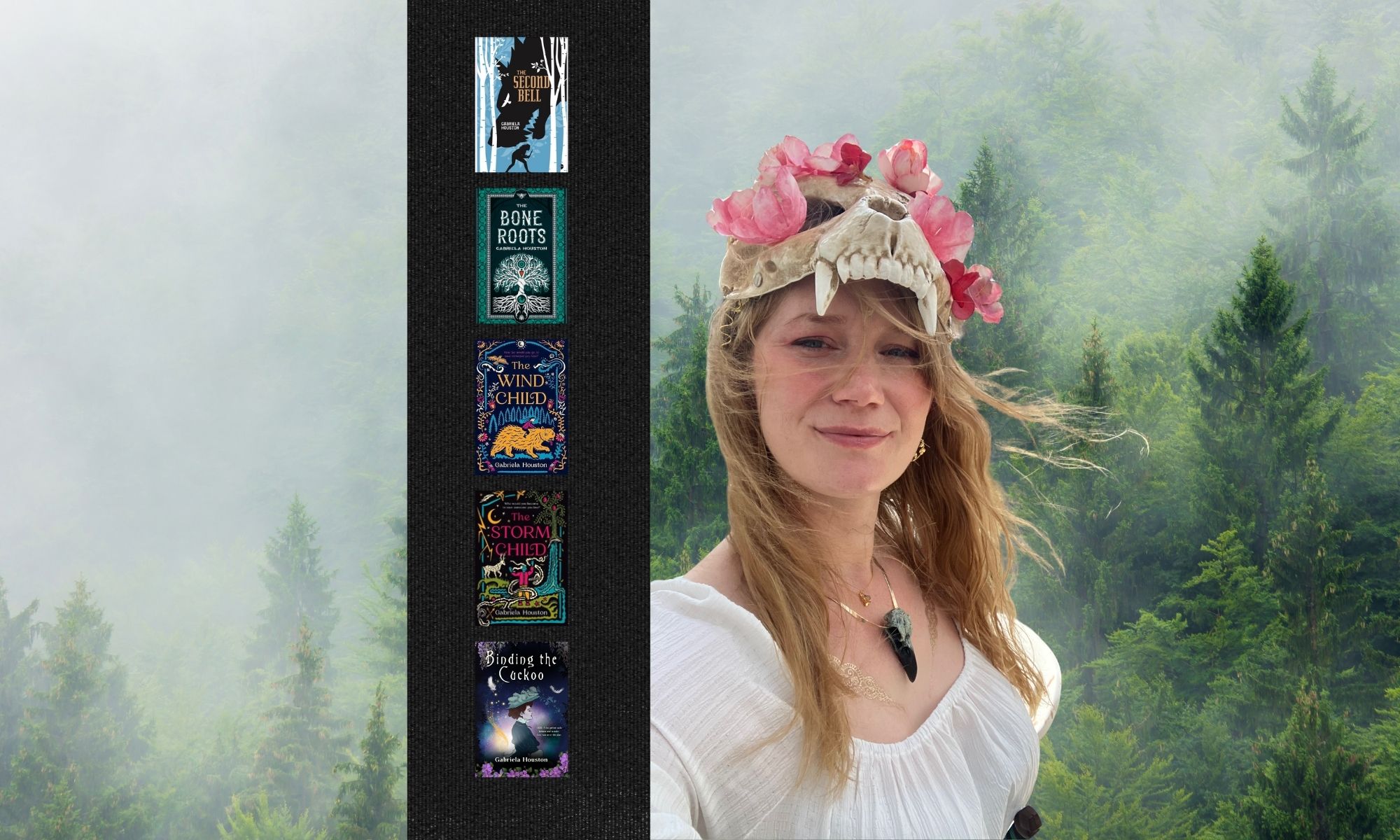
I’m really excited to announce that this year I have two Slavic-folklore-inspired Fantasy novels coming out! Something for everyone: one for adults, one for children.
The first one, THE STORM CHILD, is the continuation of Mara’s journey from The Wind Child. The sequel (and the last part of the duology) comes out in the UK May 2023 from Uclan Publishing.
The Storm Child picks up a year after the end of The Wind Child. Mara, who had her human soul ripped out of her by God Veles, is on the run from Koschei the Deathless, whose soul she’d stolen. She travels with her shape-shifting best friend Torniv, and to survive they must strike deals with gods. But in the final showdown, how much are they willing to sacrifice to protect each other? And what are they willing to become in the process? The book is now available for preorder here.
My next adult book, THE BONE ROOTS, is coming out on both side of the pond from Angry Robot Books in October 2023.
The Bone Roots is a stand-alone story about two mothers willing to do anything to protect their children.
It’s been 40 years since the Fox took Kada’s brother. Though she ran and kept herself hidden, she fears it may be stalking her again, this time to steal her daughter.
Every year, Vedma Kada gives thanks to the bone roots – those that belong to the child-bearing tree who gave Kada her desperately-wanted baby, Secha. Kada lives her life in service of the bone roots and the goddess Zemya, but they cannot keep her daughter safe. Not when Secha’s emerging powers, both mysterious and brutish, threaten to out her for who she truly is…
Meanwhile Sladyana, a rich noblewoman, has spent the last fifteen years searching for her missing daughter, Luba. She was snatched from their home by the Fox thief and Sladyana has heard nothing from her since. But the one who gave Sladyana her daughter has come within her grasp once again, and so has the secret of her daughter’s fate.
You can preorder The Bone Roots here.
A Writer’s Love Letter to Autumn

AI and the Soul of Art


THE WIND CHILD Sold To UCLan! – COMING FEBRUARY 2022

New book deal announcement!
My first middle grade (children’s) book, The Wind Child, is coming out from UCLan Publishing in February 2022!
It’s a Slavic-folklore-inspired novel about how far you would go and what you’d be willing to sacrifice to save someone you love…
It follows young Mara, the granddaughter of Stribog, the God of Winter Winds, who sets out on an epic journey with her shape-shifting best friend, Torniv, in order to bring back her beloved human father back from the land of the dead. On her way she has to rely on her wits to survive as the spirit world of gods and monsters seem determined to stop her.
I’m very proud of this book and I can’t wait to share it with you all!
THE SECOND BELL IS OUT!
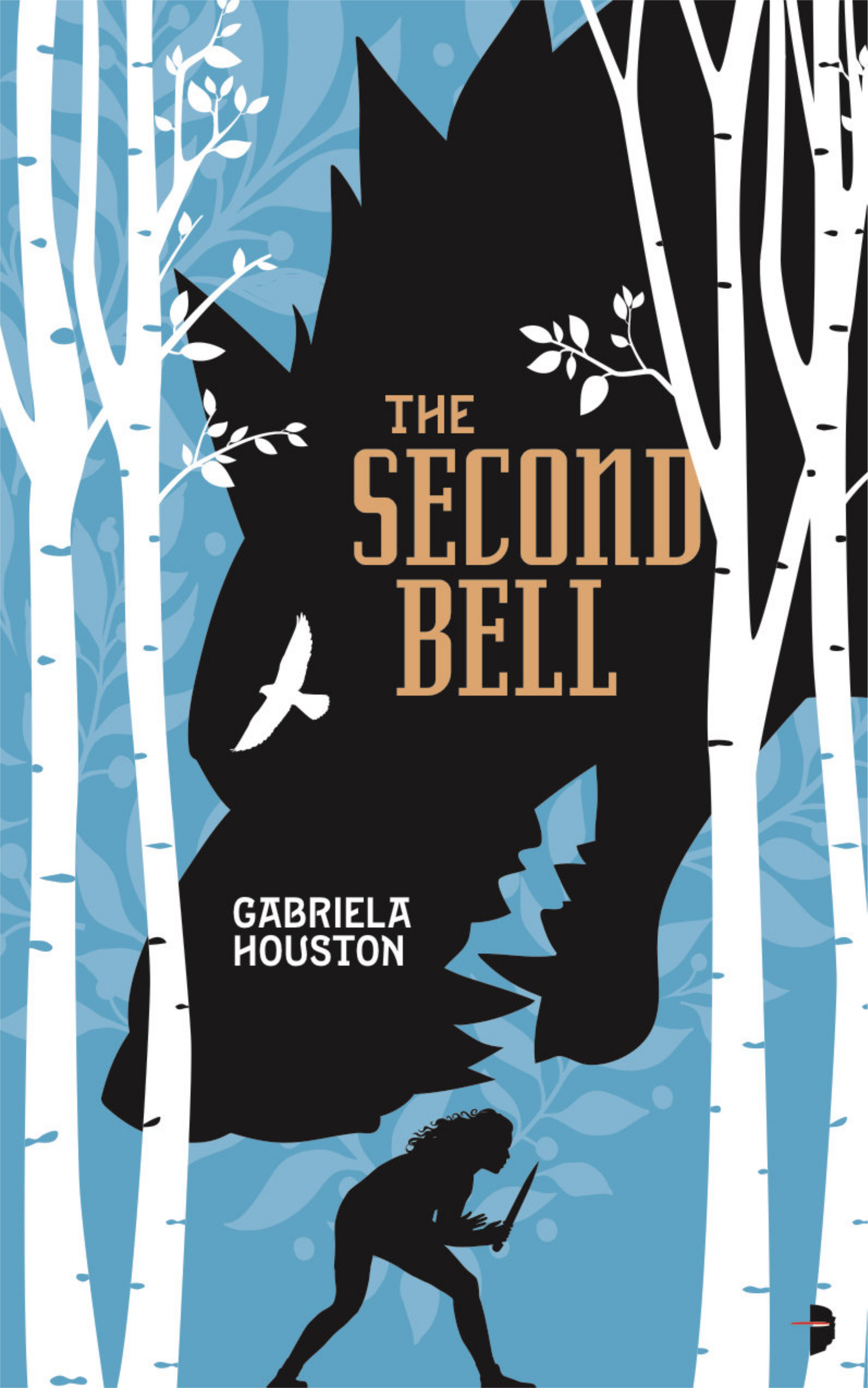
I THINK THIS IS MY NEW VOLUME BECAUSE THE SECOND BELL IS OUT AND I’M A PUBLISHED AUTHOR!
This is a quick post to let you all know that my Slavic-mythology-inspired fantasy about a striga and her mother is out in the world!
It’s available in all the formats, including audio, narrated by the very talented Dora Hart.
Here’s the smart order link: Here’s the smart order link: https://smarturl.it/thesecondbell
You can order a signed copy with a special book plate designed by yours truly from The Broken Binding bookshop (they ship internationally!)
I’m incredibly excited and I hope you all enjoy my book!
Thanks,
Gabriela
BOOKISH TAKE launching on YouTube on 1st of March!
